Newsletter Subscribe
Enter your email address below and subscribe to our newsletter

 ByJohn A
The way people search for information online is changing. Traditional search engines can provide thousands of links, while AI tools can generate long answers, summaries and conversations. Both approaches can be useful, but everyday questions often require something simpler: a clear answer that helps you decide what to do next.
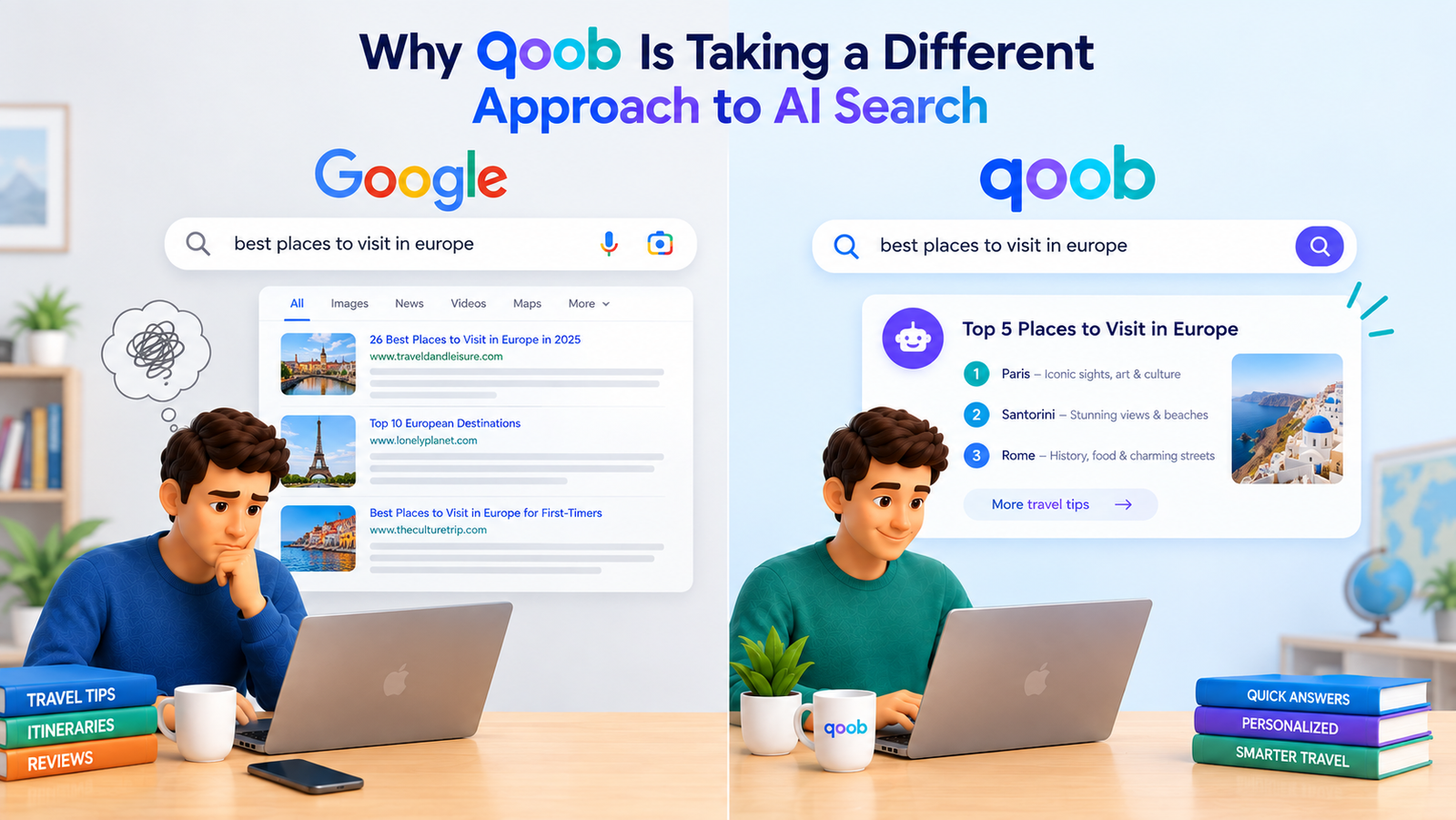
This is where Qoob takes a different approach to AI search. Instead of focusing primarily on generating content or presenting pages of search results, Qoob is designed around short, relevant answers for everyday decisions. Its goal is to make search feel simpler, more personal and easier to act on.
Qoob describes itself as a smart search and decision-making app. The idea is straightforward: users should be able to ask questions naturally without needing to understand complicated AI prompting techniques.
Rather than treating every search as a request for a long list of websites, Qoob focuses on understanding the question and providing a concise response that can help with a decision.
Many online searches begin with a decision in mind. Someone might want to know which product to buy, where to go for a weekend, what recipe to prepare or which option makes more sense.
Traditional search often requires several steps. You enter a query, open different websites, compare information and eventually decide what is useful.
Qoob aims to reduce those steps by turning information into a shorter and more practical answer.
The purpose of search is not always to collect more information. Sometimes, the real goal is to make a choice.
Qoob’s approach is built around this distinction. Its website describes the service as helping users move from searching to knowing by turning information from the web into short answers designed for everyday decisions.
AI has made it easier to generate large amounts of text. However, more text does not automatically mean a better search experience.
When someone has a simple question, a long response can create another problem: finding the useful information inside the answer.
Qoob focuses on keeping answers short and relevant. This can make the search process easier for people who want useful information without spending extra time reading unnecessary details.
The internet contains an enormous amount of information. For many everyday searches, the challenge is no longer finding information. It is identifying which information actually matters.
A shorter answer can help users focus on the main points and move toward a decision.
This does not mean that detailed research has no value. For complex subjects, users may still need multiple sources and deeper investigation. But for routine questions, a concise answer can make the experience more efficient.
Qoob is designed so users can ask questions in plain language rather than learning specific AI commands or complicated prompts.
For example, instead of creating a carefully structured search query, a user can ask a question naturally and receive an answer designed around that request.
This makes AI search feel closer to having a straightforward conversation about a practical question.
One of the important ideas behind modern AI search is personalisation. The same question can mean different things to different people.
For example, two people searching for a weekend destination may have completely different preferences. One may want a quiet location, while another may care more about activities and entertainment.
Qoob’s personal AI search approach is designed to take context and individual preferences into account rather than treating every search as completely generic.
Personalisation can make an answer more useful when the system understands what the user is trying to accomplish.
Instead of simply matching keywords, a personalised search experience can focus more closely on the purpose behind the question.
This can be especially useful when users ask about recurring interests such as travel, shopping, food, hobbies or everyday planning.
Traditional search is generally designed to provide results that can work for a broad audience.
A personal AI search experience takes a different direction. It aims to understand what the individual user means and provide an answer that better fits their situation.
That is one of the key ideas behind Qoob’s approach to search.
Traditional search engines remain useful when users want to explore websites, find specific pages or research a subject from multiple sources.
However, this process can involve opening several tabs and comparing information manually.
Qoob focuses on a different type of search experience. Instead of making users work through a large collection of links, it aims to provide a short answer that addresses the practical question directly.
For everyday questions, users may not want to read ten different articles before making a small decision.
Qoob is designed to reduce that friction by bringing relevant information together into a concise response.
This approach can be particularly useful when the question is practical and the user already knows what type of decision they need to make.
A successful search does not always end when information is found. Often, it ends when the user knows what to do next.
Qoob positions its search experience around this idea. The company describes its product as being designed to bridge the gap between curiosity and action.
AI search becomes more useful when it solves ordinary problems. Qoob focuses on practical situations rather than only complex research tasks.
Its website highlights several everyday use cases where short answers can be useful.
Planning a trip can involve comparing destinations, activities, locations and different options.
Instead of opening numerous websites for every small question, users can ask for guidance in a more natural way and use the resulting information to narrow down their choices.
Online shopping often requires comparing products, features and options.
Qoob is designed to help users compare choices without requiring them to open a large number of separate pages.
Food is another simple example. A user may have certain ingredients at home and want to know what they can prepare.
An AI search experience can help turn that question into a practical suggestion without requiring extensive research.
Not every search is about an important purchase or major decision.
People also search for things to do, hobbies to try, weekend projects and places to visit. Qoob positions these everyday decisions as an important part of its search experience.
AI chatbots and AI search tools can appear similar because both allow users to ask questions using natural language.
However, their intended purposes can be different.
A general chatbot can be useful for writing, brainstorming, conversation and content generation. Qoob describes its own focus as search and decision-making rather than general-purpose content generation.
The main focus of Qoob is finding useful information and turning it into an answer that supports a decision.
This creates a different experience from simply asking an AI system to generate a long response.
Qoob focuses on questions that people regularly ask in daily life.
These can include:
The common element is that the user is usually looking for an answer that helps them take the next step.
Privacy has become an important part of the conversation around AI search.
Qoob says that it does not sell user data and that it limits how vendors can use information. It also describes its approach as giving users more control over their search experience. These are company claims, so users should review the service’s privacy information for the latest details.
A privacy focused approach can be particularly relevant when people use AI tools for personal questions and recurring searches.
Search technology has moved from directories to search engines, then toward conversational AI and answer-focused experiences.
The next step may not simply be about producing more information. It may be about making useful information easier to understand and act upon.
Qoob’s approach reflects this shift by focusing on short answers, personal context and everyday decisions.
The company says its aim is to help people spend less time researching and more time acting on the information they need.
The biggest difference in Qoob’s approach is its focus. Instead of asking how much information an AI system can generate, the experience asks how effectively search can help a person reach a useful answer.
That distinction matters because everyday search does not always require a long explanation.
Sometimes, people simply want a clear response, relevant context and enough information to make the next decision.
As AI search continues to develop, experiences built around simplicity, relevance and personalisation may become increasingly important.
Qoob is a smart search app focused on delivering simple, relevant answers for everyday decisions.